
Coda
Risk on / risk off

A brief coda to recent notes (here, here, here).
The conclusion from the last note:
Most immediately we increasingly have irreality clashing with materiality.
The trendlines firmly point towards further escalation and incoherence. It seems increasingly unlikely that the conflict can be paused or de-escalated on a quick enough timeframe to avoid serious systemic damage.
The purpose of this note is not to say anything new, it is to emphasise a few points that are worth emphasising.
In Foreign Affairs, Mohammad Ayatollahi Tabaar suggests:
In Tehran’s view, U.S. and Israeli actions such as the assassination of Iran’s supreme leader—carried out during the Muslim holy month of Ramadan—have rendered nearly every target fair game.
Certainly, but to restate: it is worth considering how any state would react to its leadership being wiped out, regardless of the religion or time of the year. Indeed, one might observe that Iran’s response has been far more consistent and rational than its attackers.
The threat Iran faces is existential. Effectively closing the Strait of Hormuz is a card they can only play once, so there is a strong rationale that they maximise this leverage while they can. What follows is that for all the focus on the Whitehouse, the US is no longer the most important actor. Iran has been consistent in its behaviour and in steadily moving up the escalation ladder, one should presume this will continue.
If you want to work through the strategic logics at play, I would suggest this recent John Mearsheimer interview where he works through the mess with great clarity.
The FT reports on the distance between the two sides in terms of finding a resolution:
The diplomat said both the US and Iran wanted an off-ramp, but the challenge would be brokering a deal on which they could agree. The military’s reaction underlines the huge distrust between Washington and Tehran, which would have to be overcome to achieve diplomatic progress towards ending the near four-week war. “The war will continue until Americans feel its impact on their own economy — and we are not there yet,” said an Iranian government insider. “In other words, this is the real deterrence meant to ensure that Trump never dares to attack Iran again. Until that point, no one within the Islamic republic would dare engaging with any American, anywhere.”
In the case of the Ukraine conflict, it is still going after more than four years. Given all these conditions, on what grounds should we expect a quick resolution in the Middle East?
Consider what is needed for the Strait to open: a peace agreement that all parties agree on and abide by, or US/Israel destroying Iranian capacity such that they cannot threaten vessels travelling through the Strait. How likely do such outcomes appear?
What this means are the most likely outcomes would appear to be: the conflict continuing in one form or another, with the possibility of both sides moving further up the escalation ladder, or the US and Israel largely stop / pause their attacks, but Iran keeps the Strait effectively closed. And the longer the conflict continues and transit through the Strait is disrupted, the bigger and deeper the impacts across a wide range of sectors and systems.
We are fast approaching the point at which the cascade of consequences starts to really hit, and it increasingly seems that the most likely outcome is now systemic damage. As Indy Johar suggests, it appears we are going to discover, ‘what happens when the systems we have built can no longer adequately hold the complexity they themselves have generated.’
A brief overview from Alexander Campbell:
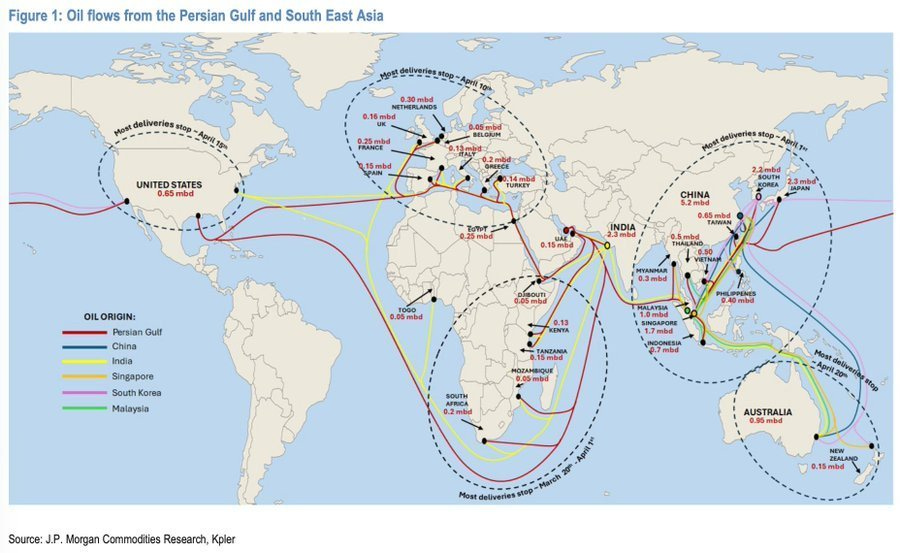
What’s important to note is the impact to energy markets is just starting to be felt. Recent research by JP Morgan’s lays out the delivery timelines from Gulf energy still in transit. Asia hits the wall April 1. Europe April 10. North America April 15. Australia April 20. But JPM’s map is still just oil, the impact of Hormuz is much deeper: fertilizer, food, helium, semiconductors, aluminum, copper, and the planting seasons that determine whether 8 billion people eat next year are all in question now.
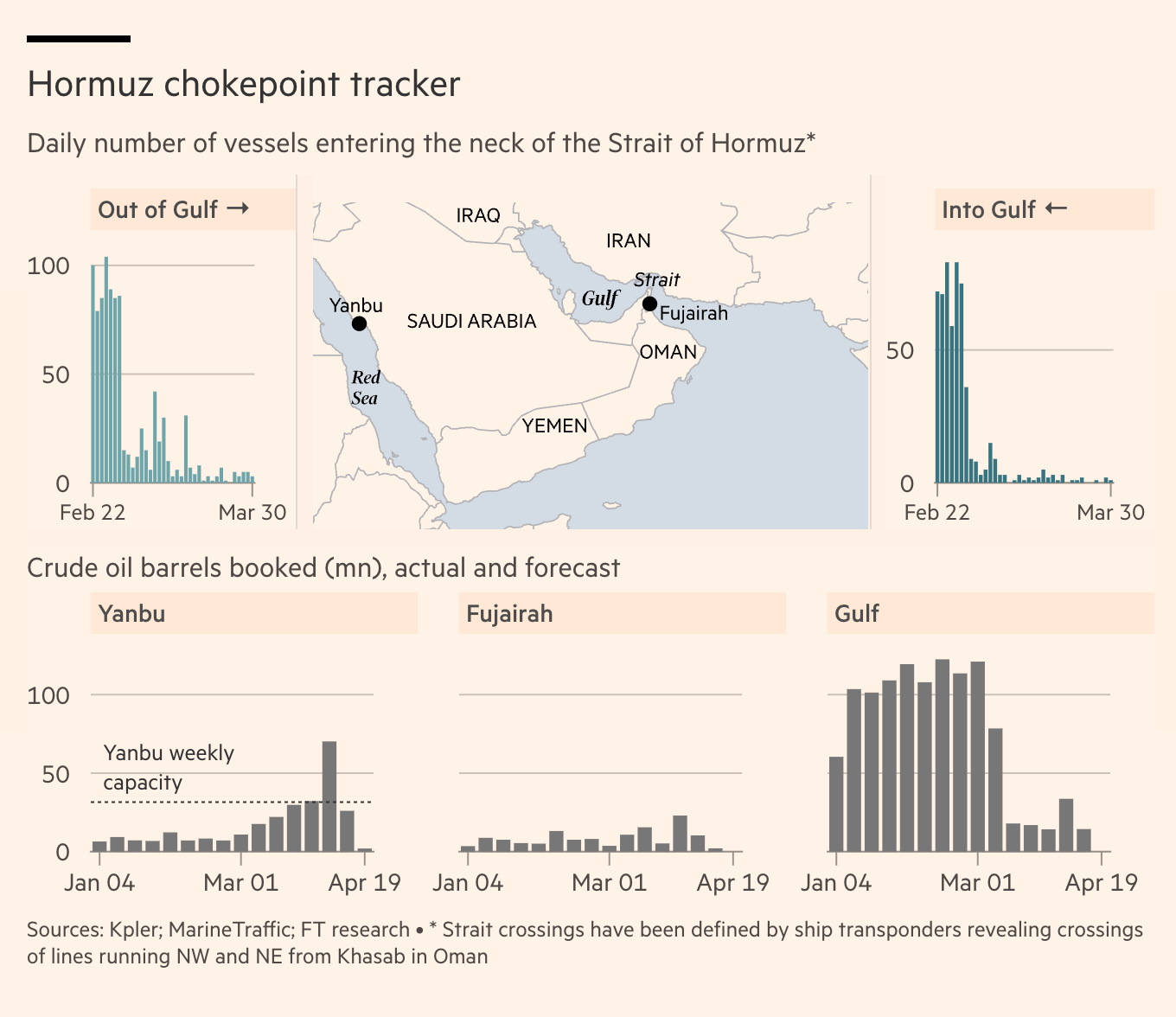
Pair that with this overview of the current situation care of the FT:
Craig Tindale judges:
“Accidental Armageddon” captures our potential reality.
We obsess over explosive nuclear end games.
Meanwhile, systemic collapse sneaks through the back door like listeria.
We engineered a hyper-complex substrate of existence, fragile algorithmic supply chains, deteriorating infrastructure, and highly vulnerable agriculture, entirely blind to its extreme brittleness under the pressure of global rivalry.
As our information ecosystems shatter, we lose the shared baseline reality required to coordinate crisis response.
Tindale as well as The Honest Sorcerer are continuing to offer analyses that work through some of the second and third order consequences that would appear increasingly likely to manifest. In the same way that signs warning of the impending pandemic first appeared in Asia before becoming global, if one looks to lower income countries there are clear signs of the shocks and stresses that appear increasingly likely to be coming.
The purpose of putting these observations together is to emphasise that increasingly the most likely direction of travel is serious, sustained global impact and damage, with growing risks of both sides moving further up the escalation ladder in a very dangerous way. Given this, things continuing ‘as normal’ - however that is presently understood - seems increasingly unlikely. What follows is the challenge of fully considering and comprehending what that might mean for us as individuals, families, organisations, and collectivities.
A new format to follow in April. For consultancy requests and other inquiries, please write to: info.hobson@gmail.com