
Bound to inbound
Nihon, noted


Golden Week is one of the annual holiday periods in Japan, a time to experience being a tourist and a traveller, and all that entails. Also an opportunity to notice patterns and predicaments. Zooming in and zooming out, connections and complications. Some inter-connected thoughts on inter-connected realities to follow.
-
The Japanese word for tourism is 観光 (kankō). Care of Gemini, which has presumably ripped this from some dictionaries and textbooks:
観 (Kan): This character translates to “to observe,” “to view,” or “to look at.” It implies a deeper level of observation or contemplation than simple seeing.
光 (Kō): This character literally means “light” or “radiance.” In the context of tourism, it refers to the “light” of a region, representing its beauty, culture, scenery, or unique characteristics.
Original meaning from classical Chinese: Translated literally, it means "observing the light of the country."
Following the pandemic, a new word has appeared in Japanese to describe the never-ending flow of international tourists:
インバウンド (inbaundo): Derived from the English term "inbound."
I would observe that this has a very different resonance to the original Japanese word. The shift is apt. The only 光 (light) present in the degraded form of tourism that prevails is is the illumination of smartphone screens.
-
I visited a country area that has had a major influx of big money, foreign and local. New hotels, new cafes, new ‘check in’ spots. It is clear that this has many benefits for the local community, and the general vibe feels much more healthy than many other rural areas. There is also a positive set of dynamics between locals and outsiders.
And yet… there is a mistaken belief that travel and tourism has become largely ‘frictionless’ care of apps and smartphones. Friction does not so much disappear, as it is moved and displaced onto the place and space that is moved through and consumed. Craig Mod has a good way of describing this dynamic:
Overtourism brings with it a corollary effect, what I call the “Disneyland flipflop.” This happens when visitors fail to see (willfully or not) the place they’re visiting as an actual city with humans living and working and building lives there, but rather as a place flipflopped through the lens of social media into a Disneyland, one to be pillaged commercially, assumed to reset each night for their pleasure, welcoming their transient deluge with open arms.
-
I read about a resort town in a different region in Japan. There is one supply line of Taiwanese tourists helping to keep a hotel afloat, but for the area as a whole ‘the mood … is gloomy.’ What is described is effectively a doom-loop of decline:
Last autumn, the region experienced an unusually quiet fall foliage season due to a surge in bear sightings.
Visitor numbers to the … area, which had not recovered to pre-COVID levels, declined even further due to the bear worries.
Since the municipal merger 20 years ago, the population decline … is especially severe… without the merger, the town’s finances might have collapsed, leading to even greater hardships.
As the population decreases, land prices fall.
And as the population decreases, the bears increase, the loop tightens like a noose.
No inboundo = moribundo
-
Too much scale, it overwhelms and overruns. This is not healthy.
Not enough, it falls and fails. This is also not healthy.
No Goldilocks, only bears.
-
Bear sightings and attacks have become a major source of concern in Japan. For the last fiscal year, 238 casualties were reported, 13 of them fatal. I drafted a note about it last autumn but never published it. The gist was it felt like another moment in which reality was acting as a metaphor: a physical, tangible manifestation of a return to a world of predators.
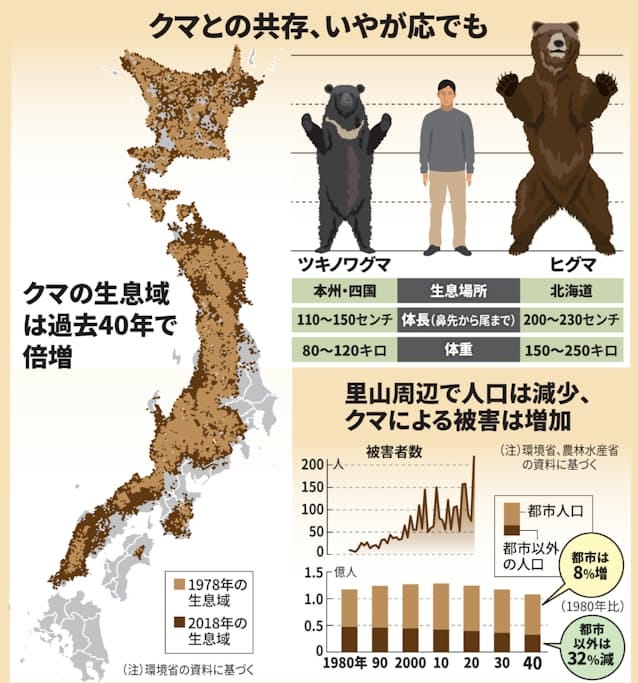
A suitably Japanese infographic from Nikkei, illustrating the increase in the bear population.
With urbanisation, demographic change and less people engaged in agriculture and forestry, the boundary between the woods and the village is becoming less clear, and bears are more willing to venture into inhabited areas. Meanwhile, on socials, people are blaming large solar power plants for disturbing the habitat of the bears. Online cooking happens in all languages and locales.
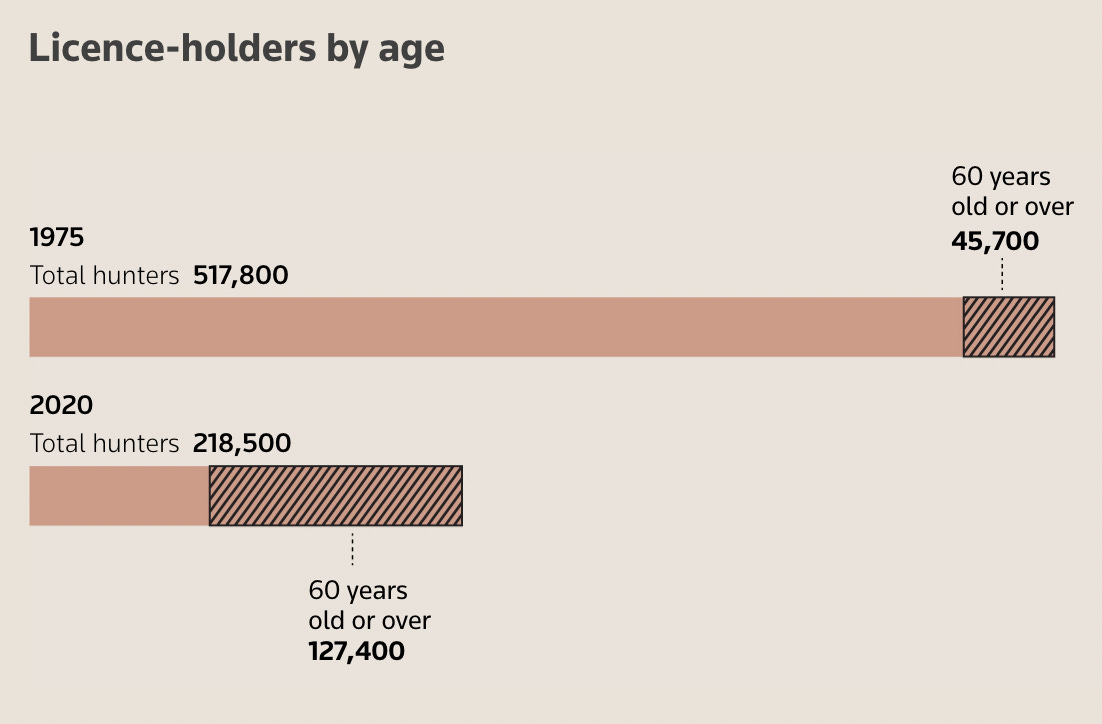
Fortunately possessing a gun in Japan is not especially easy, this means less people get shot, but also it is a bit more work to get rid of bears. Bear hunting is hard and low pay, and as with so many other professions, an ageing and shrinking population means a shrinking workforce. It might be possible to import guest workers to staff hotels, less straightforward finding bear hunters. Again, another doom loop.
And, as with so many other things, the only way out of the loop is the solution offered by tech solutionism. AI surveillance to track bears is being trialed, and surely will become more common:

-
Back atop of a ski slope, adjusted for warmer activities for locals and インバウンド to enjoy. There in the outdoors can be found an advertisement to have a Virtual Reality (VR) experience:
Collect acorns in the world of VR! Play with animals!
Offered in lieu of the real world is the kitsch of VR acorns and animals. Total Recall appears far too creative in retrospect.
There still is an under appreciation of the consequences of ceding almost total control of the space of culture and creativity to the Silicon Valley set, a mindset and mentality that has such an impoverished understanding of humanity and society. And so, we are collectively, algorithmically pushed and nudged into a beige, kitsch rendering of the world.
-
From the most recent edition of Recommendo:
Erase the crowds from your travel photos
Stillgram is an iPhone camera app that uses on-device AI to automatically remove other people from your shots. Point it at the Trevi Fountain or Shibuya Crossing, snap, and the app cleans out the crowd — leaving just the landmark. The fun part is Pro mode ($14.99), which lets you tap to choose who stays in the frame, so you can erase everyone except your kid in front of the Eiffel Tower. For an Android equivalent, try ClearCrowds.
What does this suggest about the ‘meaning’ of tourism, as it is rendered in 2026?
-
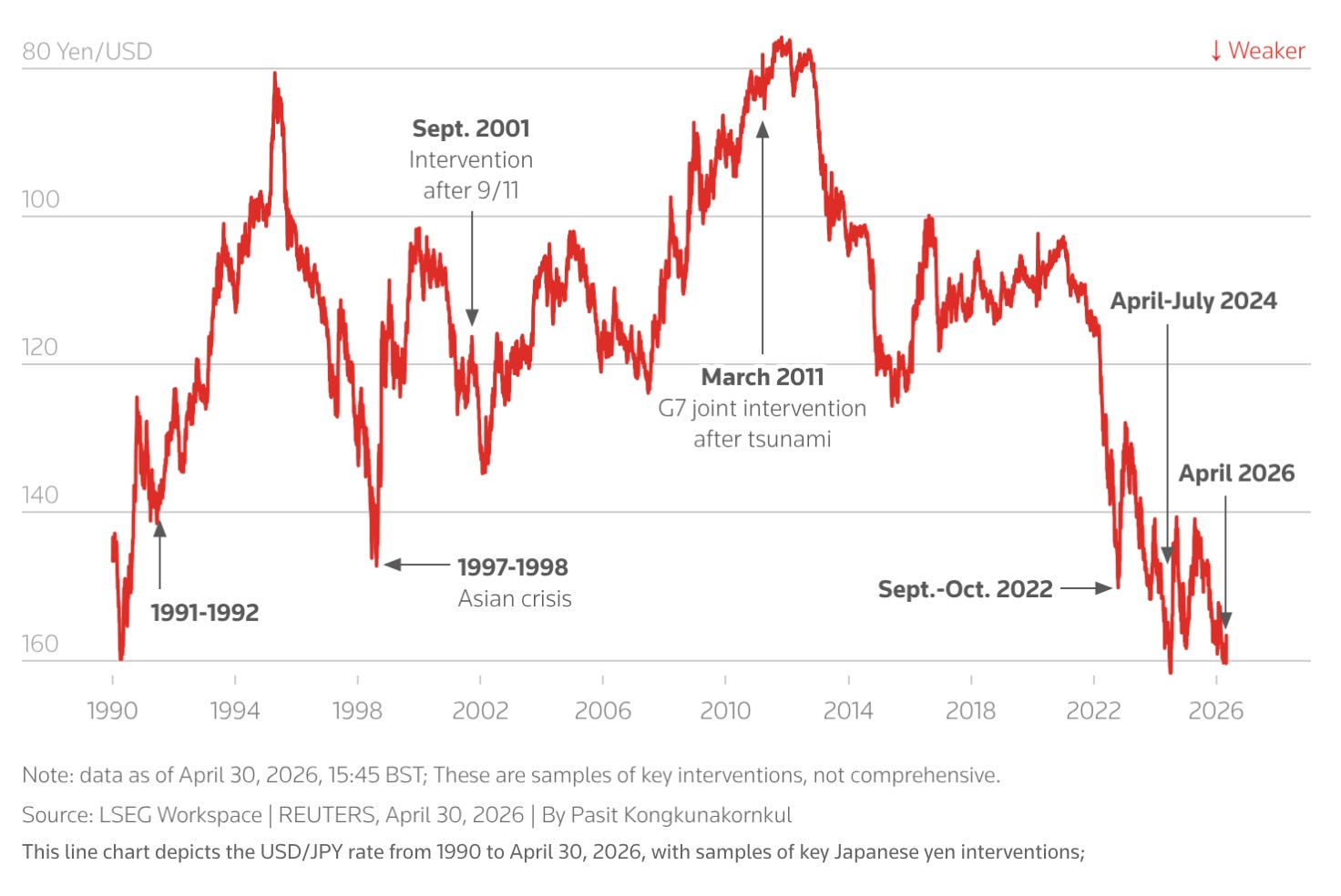
Just before Golden Week started, Japan’s Finance Minister Satsuki Katayama told traders: ‘please keep your smartphones with you at all times, whether you’re going out or resting,’ suggesting that there might be further interventions to defend the JPY. Most Japanese have been checking their phones and seeing the JPY collapse in value in recent years. This makes travel more expensive both overseas and domestically, the latter as prices are pushed up by labour shortages and the steady インバウンド wave.
There is a famous line attributed to Simon Kuznets: ‘There are four kinds of countries in the world: developed countries, undeveloped countries, Japan, and Argentina.’ Looking at the recent chart of JPY-USD, one has to wonder if there are now only three kinds of countries in the world:
-
You can notice the massive gap in recent years between Japanese travelling abroad and the amount of インバウンド being ‘welcomed’. In 2025, a record 42.7 million international visitors came to Japan, more than 15.8% increase of the previous high the year prior, and the first time it breached 40 million. How wonderful. This graph indicates the speed and scale of the increase (the drop for 2026 is because it is still only May):
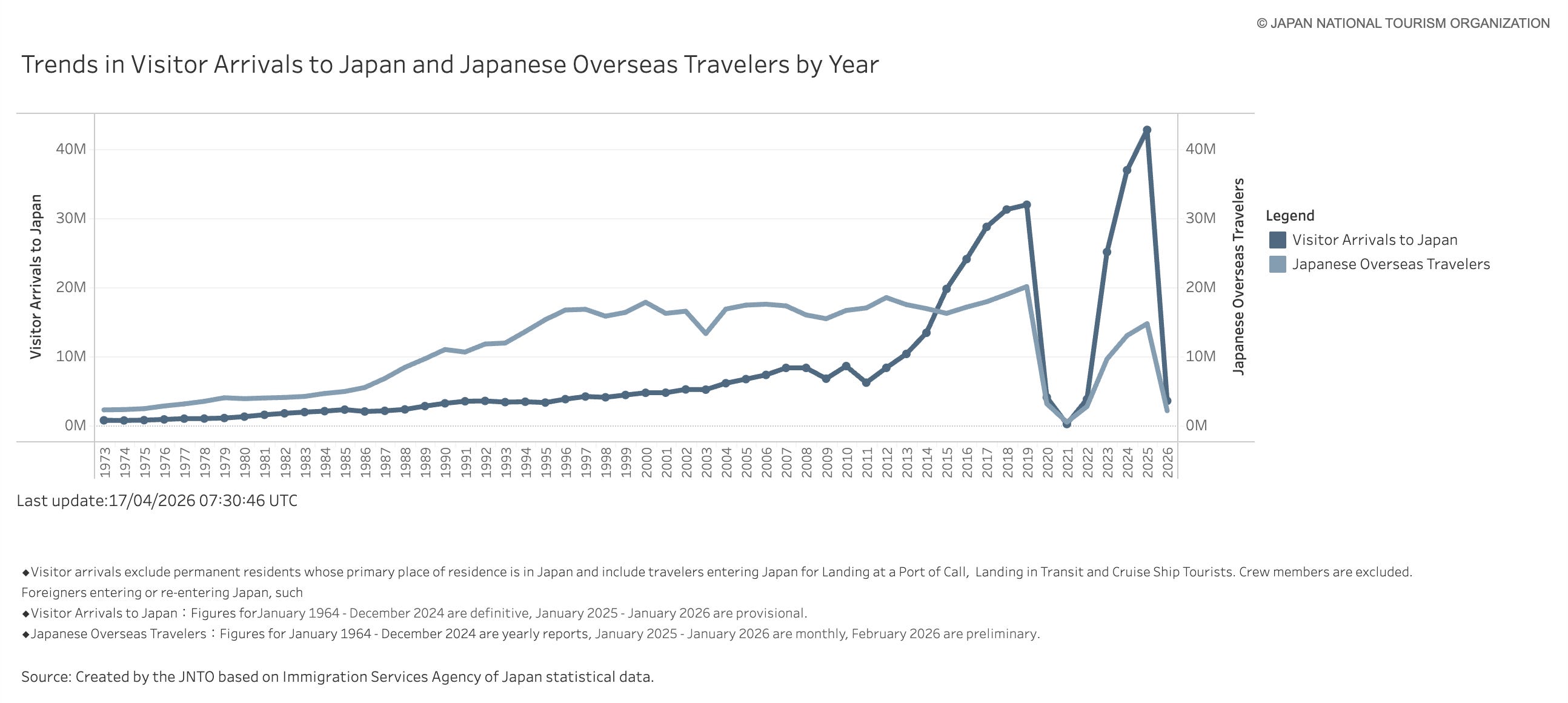
Amongst this 42 million there are people from anywhere and everywhere, but it is worth noting that more than 25 million came from South Korea, China and Taiwan. This is primarily a story about East Asia coming closer together economically and socially, even if the politics remains deeply fraught.
The largest single cohort of インバウンド in 2025 was 9.5 million from South Korea. This is not insignificant, if one recalls that South Korea’s total population is 51.6 million. I do not know what portion of those 9.5 million were repeat visitors in the year, but even if there were a lot of repeats, it still means a non-trivial percentage of South Koreans visited Japan last year (perhaps 5-10%?). Care of JNTO:
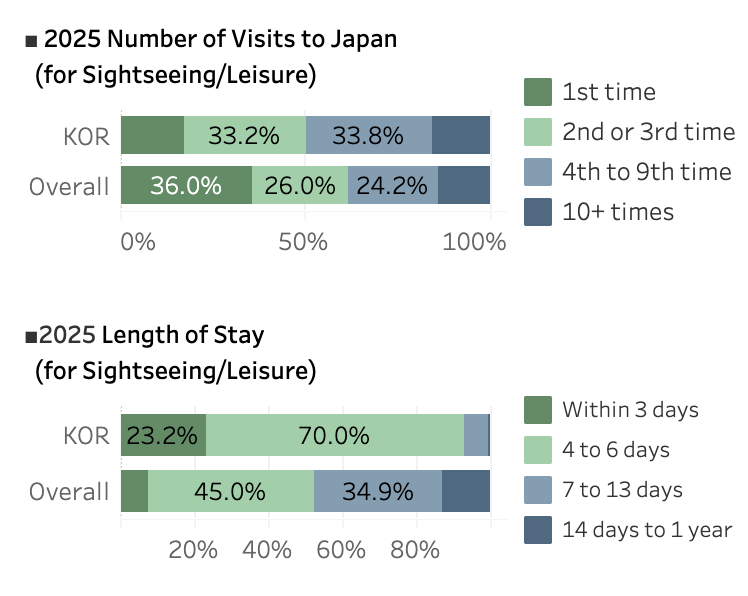
There is a tendency to focus on Western tourists because, of course, Western actors must be at the centre of our stories, but what is happening is primarily about growing interconnectivity within East Asia and Asia more broadly. An important aspect of this is affordance: the rise of budget airlines and apps makes it much easier and more affordable to travel. Add in a class of nouveau riche that have appeared alongside the region’s development, and there are plenty of people who can and do fly. It is cheaper and easier to travel, others have more money, and so everyone who can is maxxing it because they can. And, of course, traditional, authentic Japan™ looks great on social media, especially when the other インバウンド have been removed with a handy app.
-
When it comes to tourism - as with so many other contemporary phenomena - there is a real failure to properly understand it because the significance of scale is under-appreciated. When considering the number of インバウンド increasing from roughly 20 million in 2019 to 40 million in 2024-5, it is not ‘just’ a doubling of the people arriving. Rather, it is a change of form more akin to the phase change when water freezes or boils. It becomes something different. It makes sense that there is this new word - インバウンド - to describe the phenomenon, as it is different from what tourism here was. This is new, so a new term for it fits.
Likewise, a world of 8 billion people enabled through smartphones is not ‘just’ bigger and faster. It is different. There is a real need to reckon with this more directly in order to start confronting many of the harms and dilemmas we are facing.
-
Returning to the ski village that prompted some of these reflections: for now it is boom times, with new hotels, increasing property prices and so on. And yet, the clock is ticking. For how long will it last? Whether and when the インバウンド wave crests is one matter, alongside that there is the medium-term expectation that climate change will impact the reliability and regularity of the snow for which this place is famed. Day to day our attentions are pushed and pulled by algorithmic feeds, with much of our scattered focus now taken by US foreign policy resembling ‘I Am The Walrus’ by the Beatles, but meanwhile in the background environmental degradation is very much still happening. Fertiliser shortages and El Niño might be less a trading opportunity than an emergent, sharper rendering of polycrisis conditions.
-
I could talk more about the remaining radiance of bubble era museums or driving past unassuming factories that happen to be producing some of the most vital inputs for AI data centres, but enough for now. With little common and little sense, we are struggling for the common sense that is needed to wrestle with fundamental problems of speed and scale. Faced with many predicaments and few resolutions, I struggle to see how we can make any headway without regaining some sense and sensitivity to these ties that bind.